A geodesic dome designed to harvest drinking water from the air — using nothing but airflow, cooling and the sun.
There's water in the air all around us, all the time. Atmosfarm is an attempt to pull it out — to build a dome that takes in air, cools it until the moisture turns to liquid, and collects clean water you can actually use.
It's an idea I've carried for about ten years. Now I'm finally building it for real, in the open, so anyone can follow exactly how it goes — whether it works, where it breaks, and how it gets better.
Air in the top, water and food out the bottom — powered by the sun.
A hexagonal intake and a Venturi funnel pull in air and speed it up as it travels down into the dome.
Inline turbines in the duct recover energy from the moving air as it rushes through.
Solar panels provide the baseline energy that runs the cooling and the system.
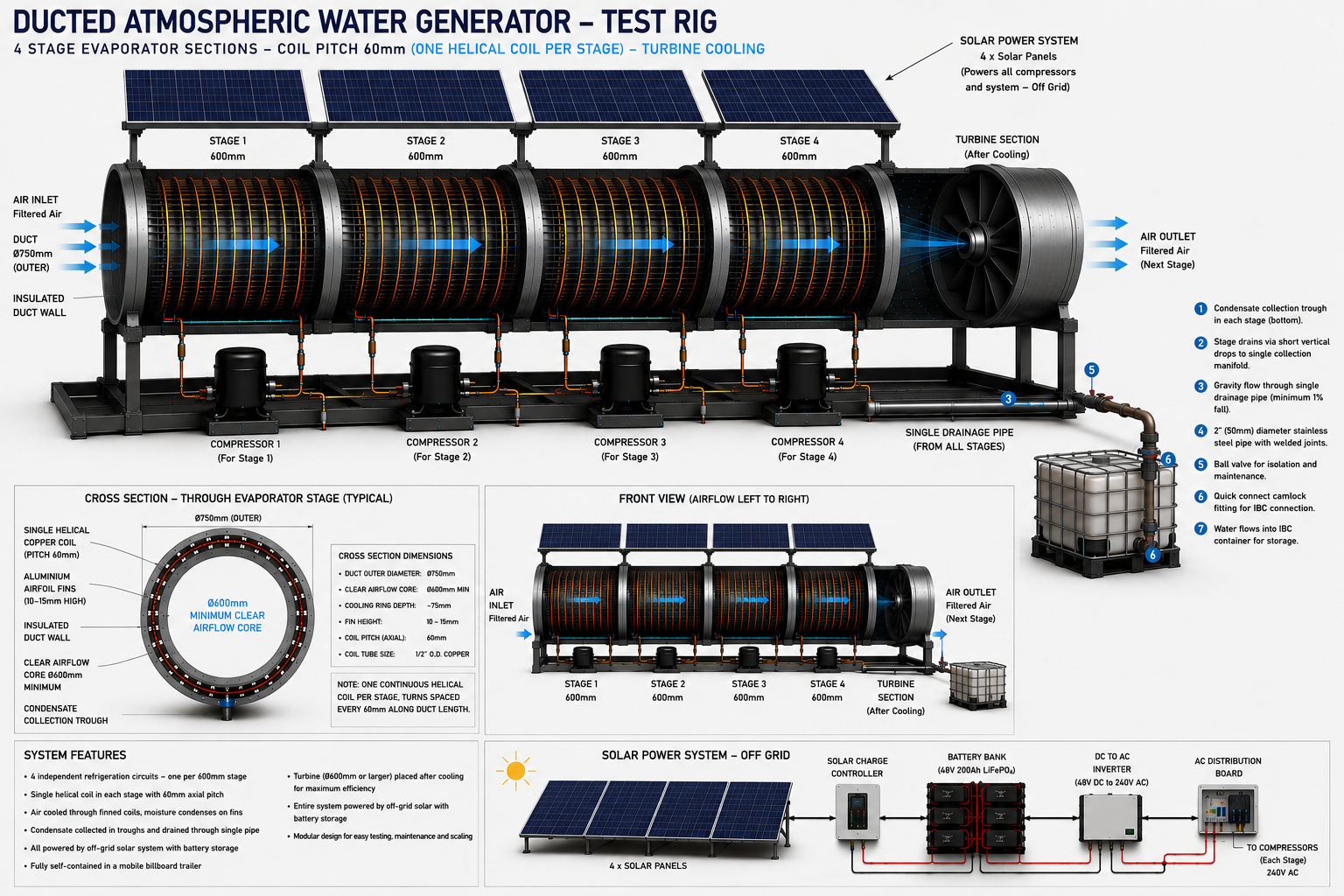
A cooling system drops the air below its dew point so moisture condenses out — then it's filtered and stored.
Inside the dome, gardens, a pond and aquaponics use the water and close the loop.

Harvesting water from air is hard — the real challenge isn't the airflow, it's the energy it takes to cool the air enough to condense water. And Adelaide is dry, so how much it produces will swing with the weather.
That's exactly why this is worth filming. I'm starting with a small, portable prototype to find out what's real before scaling up — and showing the whole thing, including the parts that don't work.
The whole build is temporary by design: screw-pile footings (no slab), a boltable frame and a portable water tank instead of a dug pond — so the site can be packed down and fully restored.
A small, portable dome to validate the concept — does it actually pull useful water from the air? Build it, test it, measure it.
The full vision: a larger dome combining water, solar energy and food production — a self-contained system for off-grid and regional living.
The full specs, numbers and design notes live in the project's production hub — the working archive behind this whole build.
The frame goes up over 100 days, starting July 6 — every step on YouTube and a 24/7 livestream.