The problem
Remote and regional Australian communities are squeezed on the three things that keep a settlement alive: energy, water and food. The infrastructure that should deliver them is fragmented, expensive and unreliable.
- High energy costs — off-grid and end-of-line communities pay a premium for power, often diesel-backed.
- Water scarcity & unreliable supply — limited rainfall, stressed bores, and trucked-in water in the worst seasons.
- Dependence on transported food — fresh produce travels enormous distances, arriving costly and degraded.
- Fragmented infrastructure — energy, water and food are handled by separate, uncoordinated systems with no shared resilience.
The solution — AtmosFarm
AtmosFarm is a modular, transportable dome that combines wind, solar, water harvesting and aquaponics into a single integrated system. Instead of bolting four separate utilities together, the dome treats energy, water and food as one design problem — positioned as an "Integrated Energy, Water & Food System" and a "Grant-Ready Engineering Concept (Australia)."
How it works — five steps
- Wind capture — incoming wind is captured and accelerated through a funnel, compressing the airflow.
- Turbines — the accelerated airflow drives inline turbines mounted in the duct.
- Solar baseline — solar panels provide the baseline energy the system runs on.
- Water — water is captured, stored and reused within the dome's integrated tanks.
- Food — an aquaponics loop produces food inside the dome, closing the cycle.
One system, three outputs
The pitch is integration: a single transportable unit that produces power, water and food, designed so the same hardware can be validated small and scaled up.6 m prototype spec
The deck's headline build target — a 6 m dome to physically validate the concept before scaling.
| Component | Value |
|---|---|
| Dome diameter | 6 m |
| Height | 3 m |
| Funnel throat | 0.4 m |
| Duct diameter | 400 mm |
| Turbines | 3 inline |
Expected turbine performance
| Wind | Output |
|---|---|
| Low (3 m/s) | 50–150 W |
| Moderate (5 m/s) | 200–600 W |
| High (8 m/s) | up to 1.5 kW |
These are the deck's marketing-facing numbers. For the full technical reality — power demand vs. yield, AWG energy cost and where the claims need tempering — see the engineering spec sheet.
Market opportunity
The dome targets settings where a single, transportable, self-contained system is worth more than four separate connections — all across Australia.
- Remote communities — energy, water and food resilience in one unit.
- Agriculture & farms — distributed production close to where it's used.
- Off-grid housing — self-contained utilities without the grid.
- Disaster-recovery infrastructure — rapidly deployable, transportable support after floods, fires or outages.
Business model
Revenue streams
- Sell modular units — direct sale of dome systems.
- License the design — license the engineering to other manufacturers.
- Government & grant partnerships — co-funded deployments and public-sector contracts.
- Ag-tech deployment — packaged systems for the agriculture sector.
Channels
- Crowdfunding (secondary) — a possible post-launch path only if audience momentum supports it; not the plan. The build itself is self-funded and the launch is a no-ask "Vision / What's Next" piece, never a fundraiser.
- Sponsorships — brand and content sponsorships tied to the build journey.
Funding stance
The 100-day build is self-funded (≈ $19,960 / ~$200/day — ~$15.7k materials + ~$4.3k hire). Monetisation is kept in the background; a permanent property is a light future note, earnings-funded, not a crowdfunding drive.Current income today
The project is bootstrapped. Present-day income comes from concreting (full-time), pizza work (weekends), and sports-card investing — there is no dome revenue yet.Development roadmap
| Phase | Milestone |
|---|---|
| Phase 1 | Lab testing |
| Phase 2 | 6 m prototype |
| Phase 3 | 15 m commercial system |
| Phase 4 | Commercial rollout |
Funding ask
The decks seek funding to build & validate a 6 m working prototype, refine the engineering, and prepare for commercial deployment.
No dollar figure stated
The decks do not state a specific dollar amount for the funding ask — the request is framed around the prototype-build milestone rather than a fixed number.Cost-of-hire analysis
A side analysis from the "cost of hire" chat: the creator wanted to hire 3 people for 24/7 coverage at minimum cost. The bare-minimum math, and why it doesn't hold.
The naive minimum-wage math
| Input | Value |
|---|---|
| AU base minimum wage | $24.90–$24.95/hr |
| Casual rate (incl. 25% loading) | ~$31/hr |
| Coverage required | 24/7 = 168 hrs/week |
| Split across 3 people | 56 hrs/week each |
| Per worker | 56 × $31 = $1,736/week |
| Three workers | ~$5,200/week |
| Bare minimum / year | ~$270,000/year |
| With super (~11–12%), equipment, insurance, sick cover | $300,000–$350,000/year |
This doesn't work
56 hrs/week per person is unsustainable — it's well beyond a normal full-time load and burns people out. And content creators aren't minimum-wage workers: even juniors expect $30–$50/hr or $250–$600/day. The 3-person 24/7 plan is the wrong shape for the job.Lean alternatives
| Option | Shape | Cost |
|---|---|---|
| A | Lean content team — 1 shooter/editor + 1 casual helper | $40k–120k/yr |
| B | Farm helper + content hybrid — 1 live-in (reduced pay + accommodation) + freelance videographer a couple days/wk | $30k–80k/yr |
| C | Contractors per shoot | $300–800/day |
Recommended
Hire 1 multi-skilled filmer/helper, 2–3 days/week, for roughly $800–1,500/week total. Start lean, then scale the team only after revenue justifies it.The tension to flag
Decks optimistic vs. engineering reality
The decks' performance claims (water yield / power) read optimistically against the engineering reality. AWG is fundamentally energy-limited; the funnel + turbine deliver roughly a 20–40% energy saving, not free water. Read alongside the engineering spec sheet before quoting any figure.Two more honest caveats: funding isn't secured yet, and the YouTube monetisation thresholds aren't met yet — so neither the grant/investor capital nor the content revenue can be assumed in any plan.
images/help-build-dome.png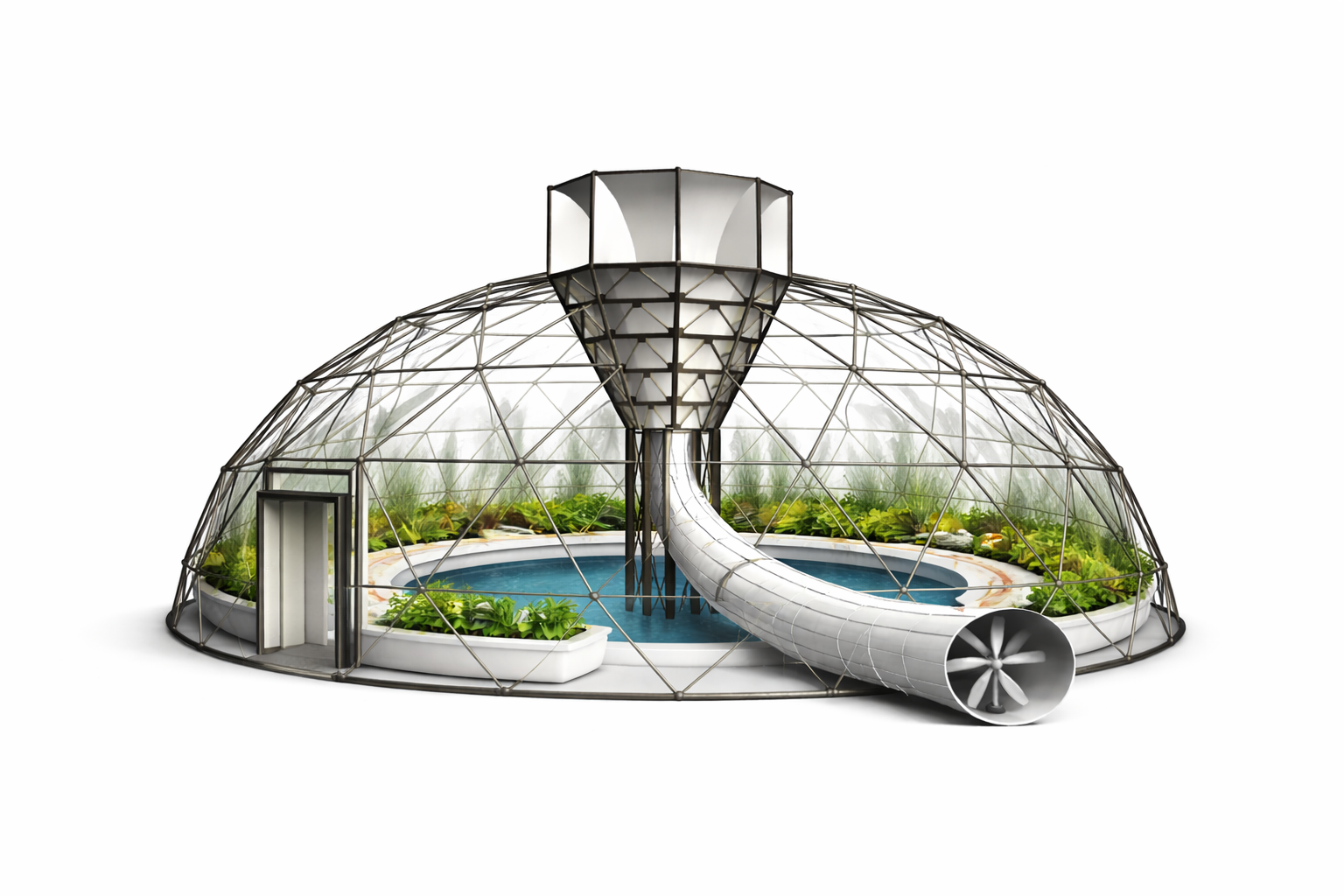
images/dome-main-concept.pngReconstructed from AtmosFarm_Grant_Document.pdf, AtmosFarm_Investor_Deck.pdf, AtmosFarm_Pitch_Deck_Pro.pdf and the 'cost of hire' chat.