It started with a skateboard
Skateboarding came first, and it never really left. Around Adelaide, that's what people knew me for — the guy on the board. It wasn't a hobby I picked up and put down; it was the lens I saw everything through. The way you learn a trick is the way I'd later learn everything else: try it, fall, adjust, try it again, and don't stop because it looks stupid the first hundred times.
I went through equipment the way some people go through shoes. If I didn't snap a deck, I'd bend the trucks, pop a kingpin, or blow out a bearing — one thing or the other, almost every session.
"Skateboarding is my life. I break a board almost every single time I come out. If I don't break a board, I break my trucks."— FROM A BOARD-TEST CLIP IN THE ARCHIVE
That habit of wrecking gear and getting back up turned out to be good training. Everything I've built since has broken on me at least once.
Nineteen, and already building
At nineteen I started a skateboard company. Most people that age are figuring out how to keep a job — I wanted to make the thing other people skated. Not long after, I opened a shop in Adelaide that was honestly a bit ridiculous when I say it out loud now: a skate shop, an arcade, and a hot dog shop, all rolled into one.
It sounds chaotic because it was. But it was the first version of a pattern I keep repeating — take a few things I love and try to weld them into one operation that shouldn't work, and make it work anyway.
That instinct — combining things that don't obviously belong together — is the whole DNA of what Atmosfarm would eventually become.
Learning to tell the story
About twenty years ago I studied Film & Television. For a long stretch I didn't really make anything with it — life filled up with work and projects and survival. But that training never fully switched off. I'd look at a sunset over the containers, or wind moving through grass, and frame it in my head.
It's the reason this whole thing was always meant to be documented, not just built. The camera was always going to come back eventually. It just took me twenty years to pick it up properly again.
The idea that wouldn't leave
Around ten years ago, I came up with Atmosfarm.
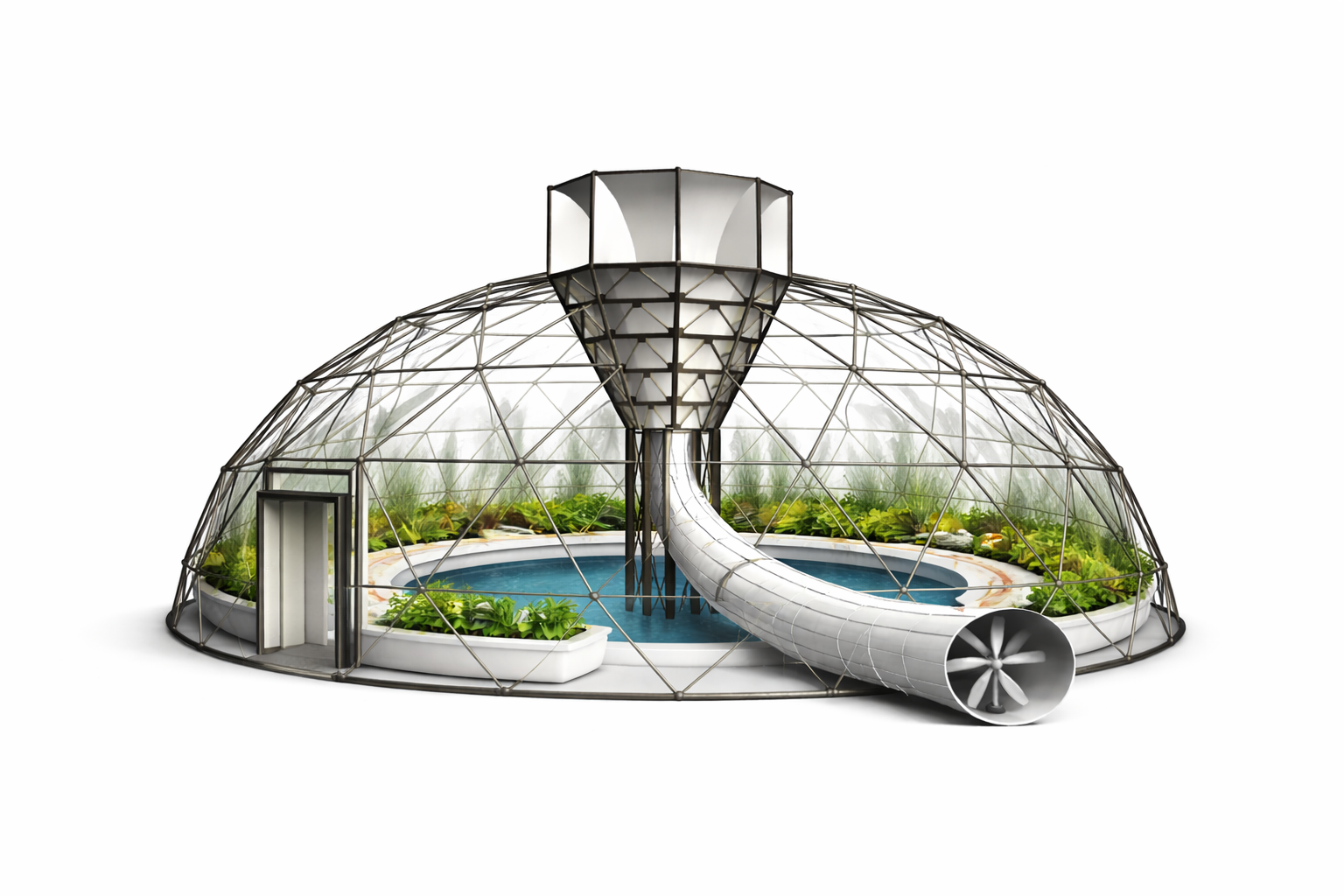
The idea was simple to say and absurd to attempt: use airflow — Venturi systems, a funnel, wind turbines — to try and pull water out of the air. Then wrap that in a dome, add gardens, a pond, water storage and solar, and somehow turn the whole thing into a working system that could support growing food and living off-grid.
"I've basically been thinking about this thing for around ten years now… use airflow, Venturi systems, wind turbines, try and pull water out of the air — and somehow turn it into a working system."— EPISODE 1 SCRIPT
For years it lived as sketches, concepts, renders and redesigns. It got refined, abandoned, picked back up, redrawn. There's a real chance I've spent a decade thinking about something completely ridiculous. I'm okay with that. The only way to find out is to actually build it.
Going off-grid
About five years ago, after a breakup, I made the kind of decision you only make when you need a clean break and a new obsession at the same time. I moved off-grid to actually try and build Atmosfarm.
The first place was a five-acre property near a military air base. It wasn't polished, but it was space — and space is exactly what an idea like this needs. For the first time, Atmosfarm wasn't just a folder of renders. It had ground under it.
A skatepark and a hundred and fifty chickens
So I built a skatepark on the property. Of course I did. And then, somewhere along the way, I started breeding chickens — which definitely wasn't part of the original plan.
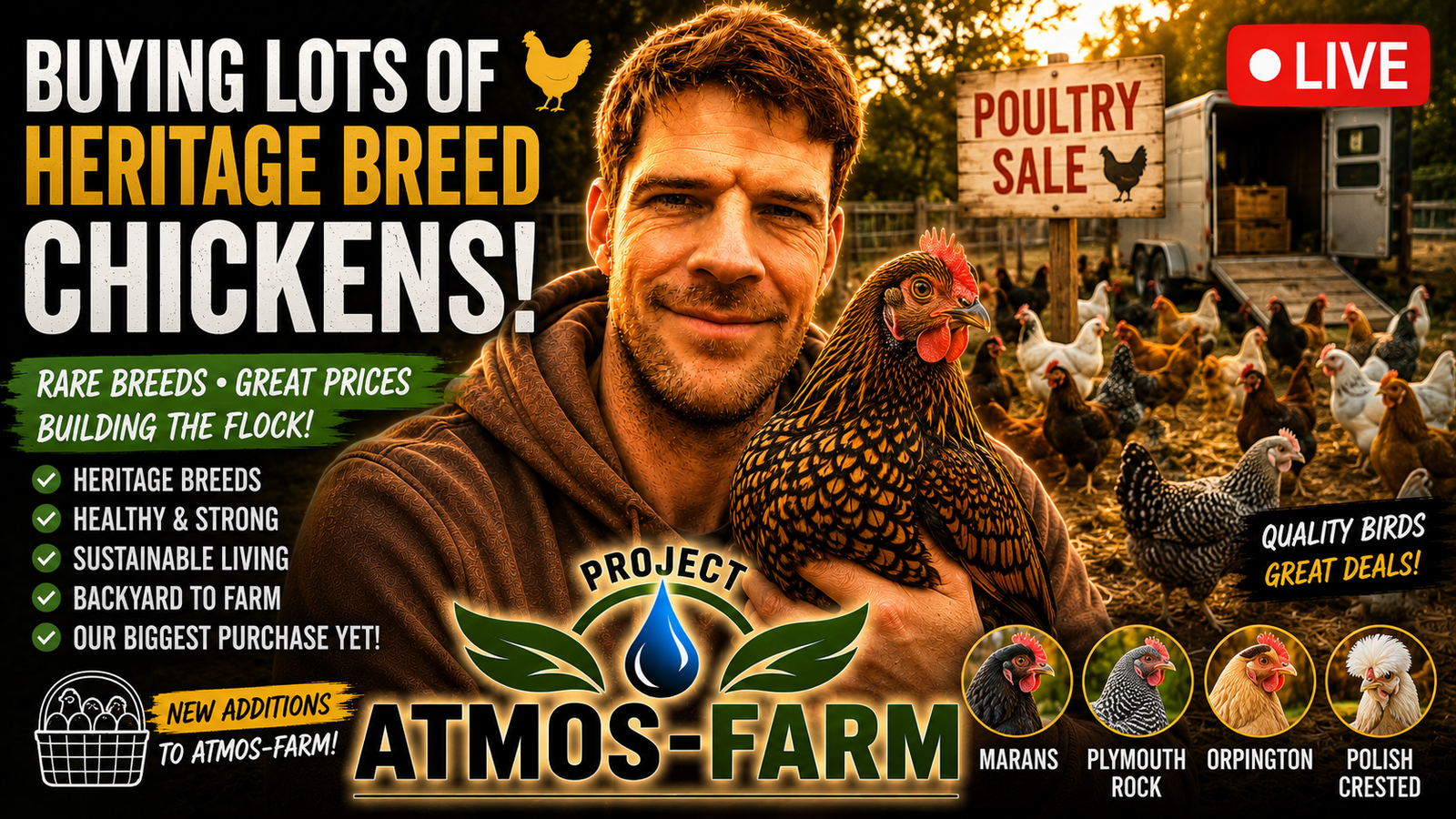
It got out of hand in the best way. At one point I had around 150 chickens across roughly 20 breeds. What started as a few birds turned into a genuine heritage-breeding operation. The skatepark and the chickens didn't have much to do with the dome on paper, but they were all the same project really: build the life you want around you, piece by piece, on land that's yours for now.
Working three lives at once
None of this paid for itself, so I worked. I poured concrete full-time during the week. I made pizza on Friday and Saturday nights. And I invested in sports cards on the side — the kind of long-game hustle that fits a brain that's always running a few projects at once.
"I concrete full-time during the week… make pizza Friday and Saturday nights… and I kind of just work on this whenever I can."— EPISODE 1 SCRIPT
That's been the real engine the whole time. Concrete pays the bills, pizza covers the weekends, and Atmosfarm gets whatever's left — which is usually late nights and stolen hours.
Sixty days and two hundred trailer loads
Then the landlord sold the property.
Sixty days to move everything. Not just furniture — a skatepark, a chicken operation, tools, containers, a decade of accumulated project. I moved it in roughly 205 trailer loads to a second property about eight minutes away, and then spent another whole year trying to rebuild what I'd just torn down.
If the first property was Atmosfarm finally getting ground under it, this was the ground getting pulled out.
Wheelbarrows, dollies and skateboards
Halfway through all of that, I lost my driver's licence.
So picture it: everything still has to move, and I can't legally drive. I moved belongings by hand — wheelbarrows, dollies, literal skateboards, and a lot of walking. The same boards I'd spent my life breaking were now load-bearing.
"I was literally moving stuff around with wheelbarrows, dollies and skateboards… the whole thing got pretty out of control. But I still couldn't let this project go."— EPISODE 1 SCRIPT
That line is the truest thing in the whole archive. Everything was telling me to quit. I didn't.
The container, and giving it all away
I packed what was left of my life into a 40-foot shipping container, parked about a kilometre away. I sold the chicken operation — the thing I'd built up to 150 birds. And I gave away a lot of belongings for free, because at a certain point holding on costs more than letting go.
You learn what actually matters when you have to physically carry all of it, by hand, to a box a kilometre down the road.
Back to Mum's — the reset
For about a year, I moved back into my mother's house. To keep working without a licence I leaned on Ubers and hotels — patching together the logistics of a working life when the simplest part of it, getting to the job, had been taken away.
It was the lowest the project ever got. Atmosfarm was a container and a folder of renders. But it was still there.
Coming back to the same ground
Eventually I came full circle and rented the second property again — the same place I'd scrambled to rebuild on before. I've been there about a year now.
The setup is pure working-class sci-fi: three shipping containers, a refrigerated truck body I use as living space, a billboard trailer, and tools, storage and filmmaking gear crammed into all of it. No proper workshop. Just the raw materials of someone who refuses to stop building.

Starting again — out loud this time
So here's where it all turns around. This time I'm not building Atmosfarm quietly and hoping it works. I'm documenting the entire thing — cinematically, honestly, failures and all — and building the prototypes in public.
I studied film twenty years ago and barely used it. Now the channel is two things at once: an attempt to actually build Atmosfarm, and an attempt to get back into creating again. I've got the cameras out — a Panasonic, a GoPro, an Osmo Pocket, a wireless setup — and a plan to start small and portable, because this property might get developed in a couple of years and the whole thing has to be able to move.
"I honestly don't know where this ends up. Maybe it works. Maybe it completely fails. Maybe it turns into something completely different. But either way… I'm finally starting."— EPISODE 1, CLOSING LINES
The dome is the foundation. Around it sits everything else that makes up this life — the engineering, the farm, the tech, the vehicles, the livestreams, the skating, the business of keeping it all alive. They're not separate channels. They're one story: building, testing, failing, improving, and never quite giving up.
After ten years of thinking about it, the only thing left to do is start. So I'm starting.
This story was reconstructed from the archive — the life-story timeline, the Episode 1 script, the branding notes, and a skateboard board-test transcript in the creator's own voice. Quotes are taken from those files. Dates are approximate ("about ten years ago", "around five years ago") exactly as they appear in the source material. Connective narration is written in the documented tone of the project; no facts were invented beyond what the archive supports. Note: early branding documents floated "LOVEGROVE" as a possible channel name, but the identity is now settled as @atmosfarm (Lovegrove remains the creator's personal name).